The Free-Range Bookclub
Bookclubbers without boundaries in Nelson, New Zealand
What We Can Know – Ian McEwan
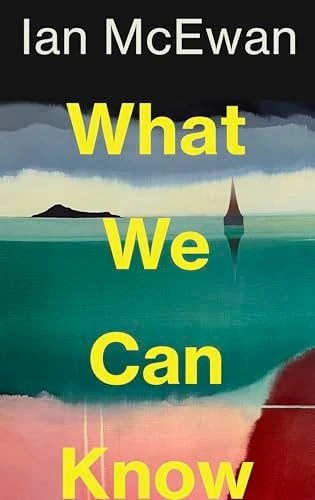
READ FOR BOOKCLUB
Chosen by Sally
In 2014 a great poem is read aloud and never heard again. For generations, people speculate about its message, but no copy has yet been found. In 2119 the lowlands of the UK have been submerged by rising seas. Those who survive are haunted by the richness of the world that has been lost. Academic Tom Metcalfe pores over archives of the early twenty-first century, captivated by the freedoms and possibilities of human life at its zenith.
I’d like to shout down through a hole in the ceiling of time and advise the people of a hundred years ago: If you want your secrets kept, whisper them into the ear of your dearest, most trusted friend. Do not trust the keyboard and screen. If you do, we’ll know everything.
Click the arrow to read each person’s full review
SALLY: cleverly constructed, dystopian world — a hefty feminist current — about nostalgia and memory and how both are imperfect sciences 4⭐️
I ordered this book at the beginning of the year and read it when it arrived, which meant I had to re-read it for book group. I have to say, I enjoyed it more the second time through. I am a fan of his work, my favourite being Atonement, but I would say it is common for me to finish his books feeling like I have missed something. So it was here. First time around, I was absolutely consumed by the plot and probably raced through the text hoping for a miraculous ending. The ending is kind of miraculous, but it is not what I was expecting.
At the second reading, I spent much more time appreciating the cleverly constructed, dystopian world McEwan has constructed. Set in a post-apocalyptic world 100 years from now, sea levels have risen and most of the UK is flooded. Society as we know it has disintegrated. Food is scarce and restricted, technology limited, world trade has collapsed, global warming is in full flight. Details such as The Bodleian having been relocated to the top of Snowdon, having to drink acorn coffee and swimming with sea turtles in an area of England that would be miles from the sea on a current map painted a rich and quite plausible picture.
The main protagonist, Thomas Metcalfe is a lecturer in English Literature, obsessed with one specific poem written before the apocalypse. The other major character is Vivien, for whom the poem was written. A whole other cast of characters swirls around the missing poem and Thomas’s hunt for it. For me this novel is about nostalgia and memory and how both are imperfect sciences. All the characters around at the time of the poem’s creation have different views and feelings regarding the so-called masterpiece. We as readers have much more insight than Thomas who, 100 years on, yearns to find the missing manuscript and share it with the present day. The title of the book What We Can Know should be followed by the subtitle “Is Not Very Much” as the passage of time, inaccurate reporting and rose-tinted spectacles all have a part in this story.
There is a hefty feminist current in this book with two wonderfully intelligent women wreaking exquisite, bloodless revenge on their egotistical husbands. The more I consider this book, the more layers I find, and my recommendation would be to savour it, think about it, do not rush it. A basic knowledge of British geography would make a difference to your appreciation of the world McEwan has created.
RACHEL: compelling plot, important message — gave me a lot to think about — respects the reader’s intelligence 4⭐️
I’ve read everything Ian McEwan has written, he’s been one of my favourite writers for a long time, and I really value how his fiction has developed. Every one of his books has a compelling plot, but also an important message. From the unsettling and psychological to humanity to civilisations, McEwan always has an astute response to the world that challenges me to ponder and Google and keep reading without making me feel like I’m completely out of my academic depth. I really appreciate how he respects the reader’s intelligence but still teaches us stuff.
The most affecting moment for me in What We Can Know is when Tom Metcalfe and his contemporaries look back on 2014 as the peak of human civilisation, a time of freedom, abundance, biodiversity, easy travel and material comfort, before climate change, political instability, pandemics, wars and rising seas. A time before “the Derangement”, when people understood the climate threat but collectively failed to respond. This message really hit home and gave me a lot to think about in terms of preserving history and protecting what we have while we have it.
McEwan wraps these ideas in a story full of murder, lovers, affairs and all the indecencies of any good plot. To be honest I found it a little slow to get going, but once the pieces are in place the narrative gathers momentum and it held my attention throughout. I think this is another of McEwan’s works that will endure and stay in the history books.
BRIDGET: McEwan’s future world very plausible — Vivien [was] weak and difficult to root for — intricate character study and literary mystery 3.5⭐️
Ian McEwan masterfully weaves two contrasting storylines: one set at the dawn of the 21st century, and the other 100 years in the future where a climate-ravaged world is surviving but with out the luxuries we currently enjoy, some food sources have been wiped out and the world has been flooded by a rising tide. I enjoyed reading McEwan’s future world, he made it sound very plausible.
The narrative revolves around a missing corona that Francis, a brilliant poet, famously read to a tight-knit circle of friends at a 2014 dinner party. The poem vanished after that night. One hundred years into the future Thomas Metcalfe, a literary scholar, romanticises about the 21st century as a “golden age”. His ultimate obsession is recovering that missing poem, A Corona for Vivien. This fixation alienates him from his pragmatic colleague and former partner, Rose who constantly challenges his idealised view of history. Thomas’s character is a mix of engaging and pitiful, more pitiful though as he obsesses over century-old emails that Vivian Blundy wrote and sometimes talks to the idea of her.
The past timeline introduces us to Vivien and her complex life. She is a deeply flawed character; who McEwan has done a great job of developing. She balances being a caretaker for her first husband, Percy (a gentle violin maker suffering from early-onset Alzheimer’s), with her turbulent second marriage to Francis. Vivien handles her chaotic life by engaging in numerous affairs. Personally, I didn’t gel with her; I found her weak and difficult to root for, though the sheer number of affairs definitely hints at a deeper thematic meaning about human connection.
If you love intricate character studies and literary mysteries, this is well worth the read.
TESSA: appreciated thoughtful exploration — struggled to connect emotionally — gave me plenty to think about 3.5⭐️
This is the first Ian McEwan novel I have read and I enjoyed it overall, however it wasn’t a perfect read for me. I found the writing beautiful, and appreciated the thoughtful exploration of memory, truth and how we make sense of the past. The mystery kept me interested, but fell a bit flat with the pacing slow at times.
What I liked least was the amount of infidelity in the story. It felt more prominent then I expected, and I found it distracting and frustrating rather then adding much to the novel. I also struggled to connect emotionally with some of the characters. Even so, the book gave me plenty to think about, and I’d recommend it to readers who enjoy literacy fiction with big ideas.
JODIE: shows how history can be highly speculative — powerful metaphor — thoughtful and thought-provoking 3.5⭐️
What We Can Know is a cleverly written dystopian novel that explores climate change, memory, and the fragility of history. The significance of the missing poem and what Tom tried to discover shows how history can be highly speculative, often based on educated guesses rather than anything truly concrete.
The novel unfolds gradually, and I liked how the first part, which initially felt quite speculative, became much clearer after reading the second part. Once the real story emerged, it gave the earlier sections much more meaning.
One of the ideas that stayed with me was the question of what would happen if a major global event occurred today. Would we lose much of our history, especially when so much of our lives exists only in digital form? The disappearance of the poem serves as a powerful metaphor for how difficult it can be to preserve cultural artefacts in our data-heavy world.
By the end of the novel, I was left reflecting on our planet’s future and the possibility of losing not only the environment but also the stories, knowledge, and history that define us. It is a thoughtful and thought-provoking read.
Published 2025
Knopf
303 pages

We're
currently
reading


Recent Comments