The Free-Range Bookclub
Bookclubbers without boundaries in Nelson, New Zealand
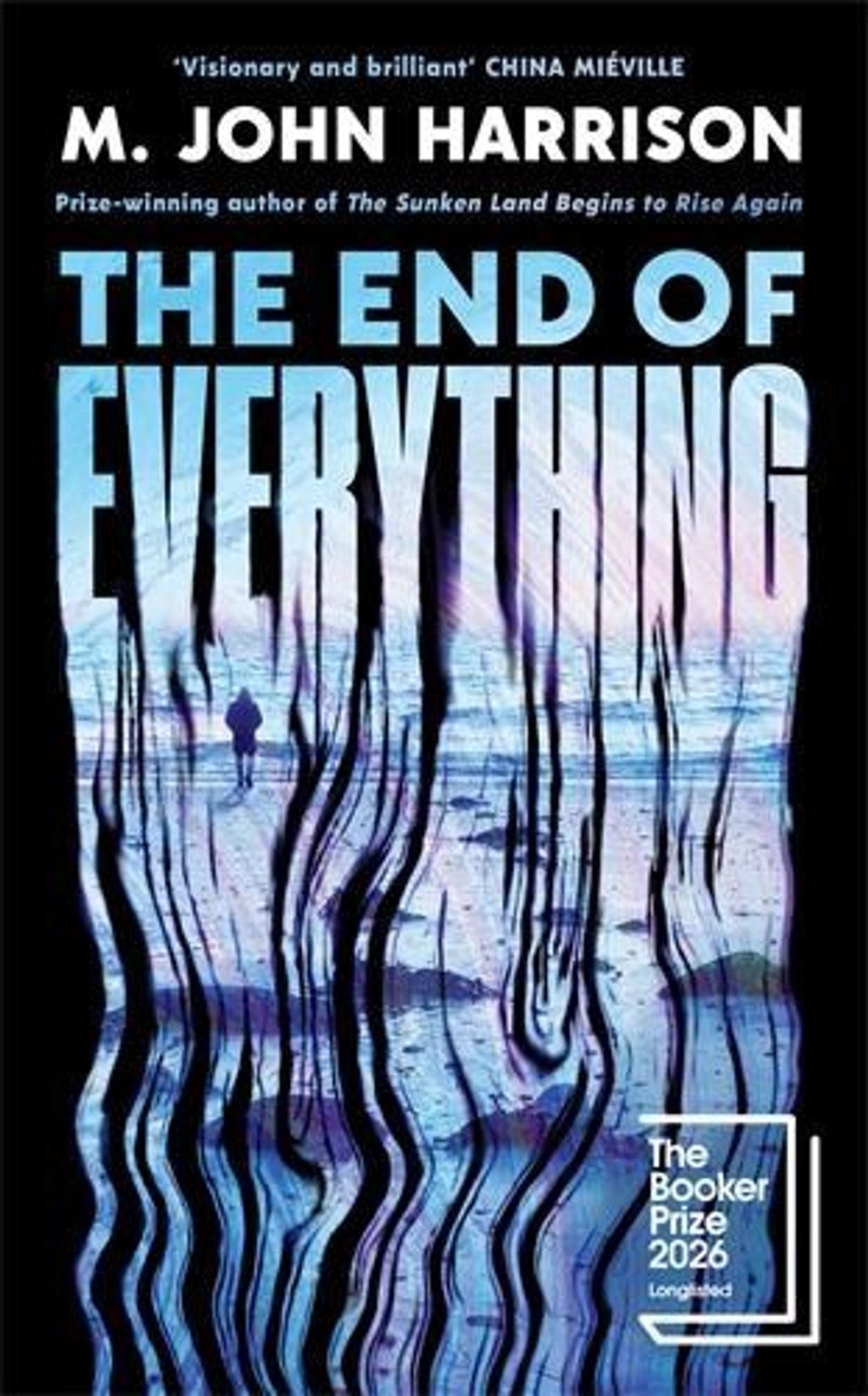
The End of Everything – M John Harrison
READ FOR BOOKERTHON
The End of Everything is a speculative novel set in a future where an unexplained crisis has transformed the world, and strange new life forms coexist with humans. Phillip Tennent makes his living collecting artefacts washed ashore from the English Channel, until he discovers a mysterious, ever-changing creature that he takes inland. Combining dystopian fiction, science fiction and satire, the novel uses an unconventional narrative and elements of the absurd to explore humanity’s relationship with the unknown.
Use of this term was as problematic as the crisis itself. People often described the City of London as ‘the bad patch’, the most noticeable, most permanent evidence that things had gone wrong. But they would also describe a change in their local reality as a bad patch as if it were a basically economic fluctuation, reducing the value of their houses or the social capital concentrated on their bookshelves or in the art on their walls. ‘The country’s going through a bad patch,’ they might say. Or: ‘We’re coming out of a bad patch in our lives.’ Using the phrase in its older, pre-crisis sense – the way you might talk about a failed marriage or career – was perhaps an unconscious attempt to normalise the inexplicable and minimise the disaster.
SUZY
● There’s always at least one Booker shortlister that humbles me and The End of Everything has certainly done just that.
A review from the Observer on the back cover says “Extremely beautiful … I don’t think I’ll read a better book this year, perhaps decade”. I prefer the one from the Guardian on the front cover that says “Dreamlike and baffling” as it more accurately sums up my reading experience. If it wasn’t for the back blurb I wouldn’t really know much about the storyline, other than it’s set in a dystopian future that seems to have been brought about by climate change.
There is a menacing presence creating a sense of unease and discomfort for the reader and my complete bewilderment in figuring out what’s happening seems to be mirrored by the characters. Strangely, I still enjoyed this book although I don’t think I’d win many friends by recommending it.
RACHEL
● This is a hard book to figue out. It’s intelligently written and despite not fully understaning what was happening half the time, I did always want to read on.
Despite it’s science fiction categorisation, it isn’t your usual dystopian setting where humanity is battling an alien invasion and trying to reclaim the planet. Instead, alien life coexists with the population. They are referred to as iGhetti but never fully explained. I wasn’t sure if they were a living being or some form of artificial intelligence. A man named Phillip finds a treasure on the shoreline and hurries off with it. It grows, is clearly alive and goes everywhere with him. Meanwhile, his aunt Marnie kills a boy then goes on a road trip with a gun and hot views on religion.
I don’t think this is a novel for the general reading population. It is too abstract and requires someone who is willing to dissect it page by page. I have not done this, as you can probably tell from my ambiguous review, but I am looking forward to doing so in person with Suzy.
Published 2026
Serpent’s Tail
208 pages

We're
currently
reading


Recent Comments