The Free-Range Bookclub
Bookclubbers without boundaries in Nelson, New Zealand
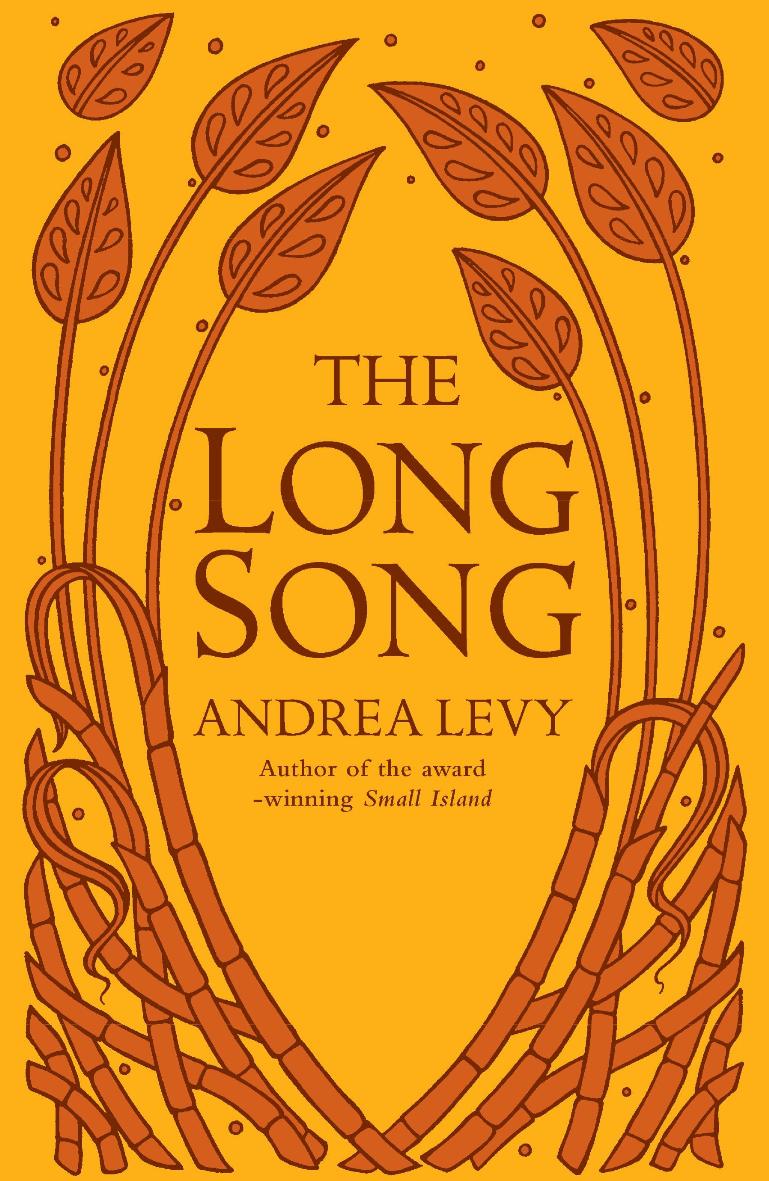
The Long Song – Andrea Levy
 READ FOR BOOKERTHON
The story of July, a Jamaican slave who witnesses both the atrocities and abolition of slavery
You do not know me yet. My son Thomas, who is publishing this book, tells me, it is customary at this place in a novel to give the reader a little taste of the story that is held within these pages. As your storyteller, I am to convey that this tale is set in Jamaica during the last turbulent years of slavery and the early years of freedom that followed. July is a slave girl who lives upon a sugar plantation named Amity and it is her life that is the subject of this tale. She was there when the Baptist War raged in 1831, and she was present when slavery was declared no more. My son says I must convey how the story tells also of July’s mama Kitty, of the negroes that worked the plantation land, of Caroline Mortimer the white woman who owned the plantation and many more persons besides – far too many for me to list here. But what befalls them all is carefully chronicled upon these pages for you to peruse. Perhaps, my son suggests, I might write that it is a thrilling journey through that time in the company of people who lived it. All this he wishes me to pen so the reader can decide if this is a novel they might care to consider. Cha, I tell my son, what fuss-fuss. Come, let them just read it for themselves.
☁ The above exert from The Long Song offers a good synopsis of what the book is about. And Andrea Levy is in a good position to tell the story, being the child of Caribbean immigrants. (Her parents sailed from Jamaica to England in the late 40s). Andrea was born in London in 1956, and growing up black in what was still a very white country provides her a unique perspective about living in both worlds.
The book’s main character July is a mulatto, the daughter of a Scottish overseer and her slave mother. Her life, and the lives of those around her are fraught with intensity: sexual assault, affairs and unexpected pregnancies. The book follows July’s experiences and reactions to these events, culminating in the Baptist war of 1831 and the uprisings that followed. All the main characters are given equal investment in this story meaning it’s it up to us, the reader, to make up our minds about what is right, wrong or merely survival. The narration style assists in ensuring the reader is heavily involved in the unveiling of the story.
The result is a work of literary merit that we both found highly moving. It covers a great deal of events and historical detail without too much misery or false hope, and the plot keeps the pages turning.
—–
Published 2010
Charnwood
416 pages
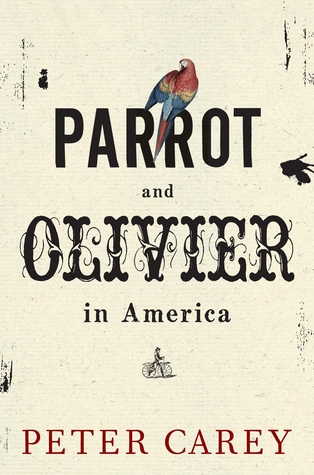
Parrot And Olivier in America – Peter Carey
 READ FOR BOOKERTHON
Olivier, a French aristocrat, sails for the New World with his servant Parrot
☁ “Olivier-Jean-Baptist de Clarel de Barfleur de Garmont is a young French nobleman who attends democratic lectures in his homeland and is suspected of being a spy. He is advised to move to away from the unwanted attention, as far away as America. He does so, taking with him John Larrit, aka Parrot as a secretaire, whose family printing business went up in flames.
On the ship the men lament the friends and lovers they have left behind, though there are a few surprise re-appearances, and also new turmoil and lustful adventures on the long voyage.
Once in the New World the men decide to investigate the penal system but struggle to agree upon their journeys and exploits, which more often than not turn out to be troublesome. The men quarrel and make up, collecting women and friends/enemies along their adventures.
The story is told in first person by Parrot and Olivier in alternating chapters, each portraying their unique perspective on events. Their narratives highlight one of the book’s main themes, the class difference between aristocrats and commoners. In the New World they agree to arrive as friends rather than master and servant however, the way in which the men treat others and view rules and laws demonstrates that behaviours related to class division are difficult to let go of.
I have traveled widely. I have seen this country in its infancy. I tell you what it will become. The public squares will be occupied by an uneducated class who will not be able to quote a line of Shakespeare.
Rachel and Suzy both agreed the book was full of fabulous characters, was well-paced and full of intrigue. However Rachel’s attention wavered and she didn’t pay as much attention as she should have to the details, affecting her overall view of the book. Suzy on the other hand was enthralled with the characterisation and the adventures and captivated throughout, noting it as a substantial literary and historical work.
—–
Published 2009
Hamish Hamilton
464 pages
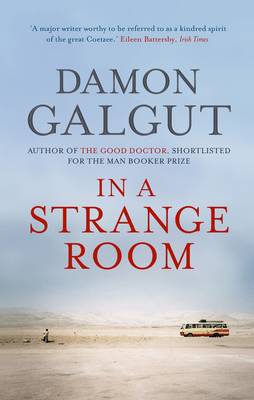
In A Strange Room – Damon Galgut
 READ FOR BOOKERTHON
A South African writer named for the author goes backpacking abroad.
☁ A young man, named for the author, undertakes three journeys to different countries where he meets and enjoys the company of strangers, but seems to attract bad luck.
In Part I, titled The Follower, he travels to Greece and meets a fellow walker. They become friends and decide to tackle a walking trip together in South Africa. However, tensions arise in their contrasting personality types.
Part II is called The Lover and is set in Africa. In it, Damon, the protagonist, meets three European backpackers. Though he tries to avoid them he crosses paths with them several times before falling for one of them. He is then unable to decide whether he should continue to avoid them or attach himself to the group and follow the potential love interest.
In the final part, Damon accompanies a friend to India where he is entrusted with her care for her mental health is unsettled. In this section he is The Guardian, but struggles to live up to his caretaker role.
I don’t like leaving the road, my sense of vulnerability deepens, a sort of primal nervousness descends. But this is also one of the most compelling elements in travel, the feeling of dread underneath everything, it makes sensations heightened and acute, the world is charged with a power it doesn’t have in ordinary life.
The man’s actions are deliberate and thoughtful and detail his search for both meaning, for love and a place to call home. Adding to the mystery about whether the book is autobiographical or a unique type of fiction, is the dual point of views that sometimes change within a sentence.
In A Strange Room challenges genre stereotypes and we both felt we were being rewarded for reading the text more attentively than usual. It is an intellectual book that blurs the lines between fact and fiction that provided far more enjoyment than simply a moment of escapism.
—–
Published 2010
Atlanic
256 pages
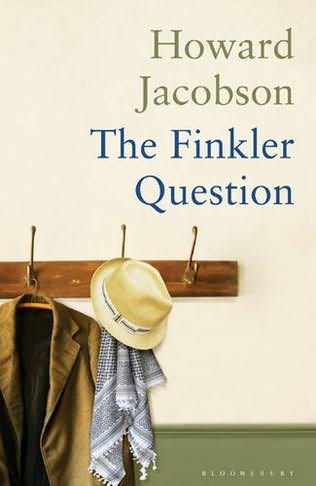
The Finkler Question – Howard Jacobson
 READ FOR BOOKERTHON
A satirical novel where three British men reflect on what it means to be Jewish.
☁ “Julian Treslove is a professional lookalike, despite not looking like anyone in particular. His friend Sam Finkler is a philosopher, writer and television personality. Their former teacher, Libor Sevcik, is a Czechoslovakian concerned about the world.
One evening they dine at Libor’s central London apartment, reminiscing about their lives and discussing what it means to be Jewish. Julian is a recent convert and struggling with his new found identity. He considers Sam a total representation of Jewishness and uses his surname to stand in for the word Jew, hence the book’s title.
On his way home, Julian hesitates outside a shop window and is attacked. He becomes obsessed with the belief that his female attacker may have called him Jewish. This sets off a chain of events where the characters being to analyse their own Jewish identities but also how others interpret them, too.
That’s good, Julian. Getting touchy is a good sign. You can’t be Jewish if you can’t do touchy.
Suzy and Rachel agreed there was a nice level of humour and moral, a touch of reality and loveable characters in The Finkler Question. It was a satisfying read with outstanding prose and language. We enjoyed and respected it, but we didn’t find it overly exciting or stimulating. Perhaps because we are quite removed from the life which contemporary British Jews live, and therefore do not have the level of understanding that other readers may do about how Jewishness is integrated and regarded by the British population. There was a level of education here for us, for which we both were grateful, but as a read for a read’s sake, for enjoyment and to wile away a lazy Sunday afternoon in Aotearoa, it wouldn’t be our first pick.
—–
Published 2011
Bloomsbury
384 pages
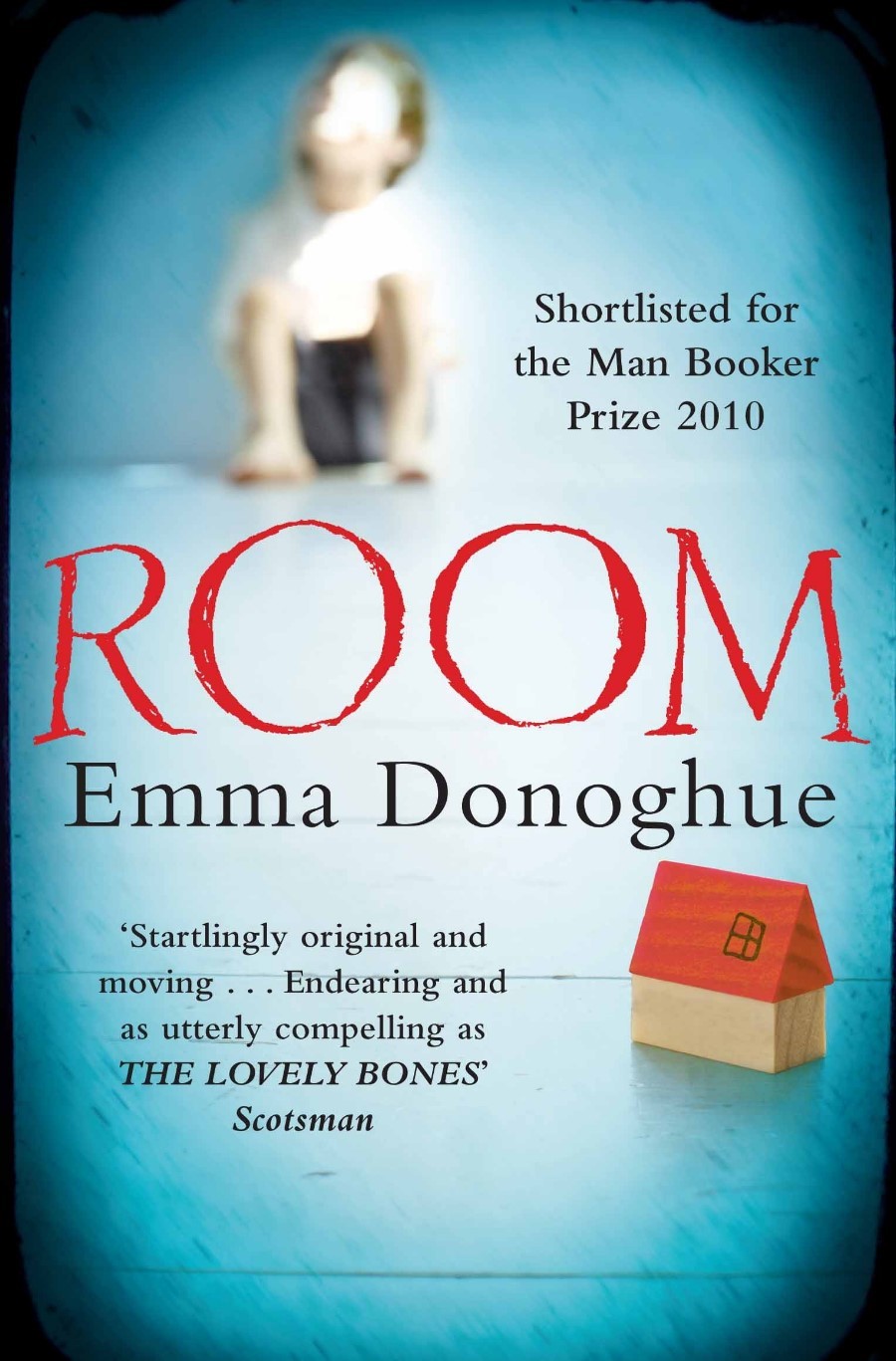
Room – Emma Donoghue
 READ FOR BOOKERTHON
A boy and his mother are held captive in a single room which has become their world.
☁ Room is told from the perspective of a five-year-old boy who is being held captive with his mother. The boy was born in the room and has no understanding of the outside or real world. Only the games he must play and the places he must hide when Old Nick comes to visit his Ma.
Room is home to Jack, but to Ma, it is the prison where Old Nick has held her captive for seven years. Through determination, ingenuity, and motherly love, Ma creates a life for Jack. But she knows it’s not enough and devises a bold escape plan, one that relies on her young son’s bravery.
Room was inspired by the real life Fritzl case.
Outside has everything. Whenever I think of a thing now like skis or fireworks or islands or elevators or yo-yos, I have to remember they’re real, they’re actually happening in Outside all together. It makes my head tired. And people too, firefighters, teachers, burglars, babies, saints, soccer players and all sorts, they’re all really in Outside.
Though topical, we both found the plot in Room too convenient and sewn up. Even the young-child narration didn’t really work. Rather than a heartfelt innocence’s point of view, the book had a childish air. Too much was spelled out, over explaining what the boy was hearing but not understanding. The reader needed to be given more credit and the story could have been told through nuanced tidbits of information instead. It felt like the true horror of the Fritzl case was trivialised by this book. We were both surprised Room was shortlisted for the Booker.”
—–
Published 2010
Little, Brown & Co
336 pages
C – Tom McCarthy
 READ FOR BOOKERTHON
C is a 1960s-, modernist-style anti-novel steeped in philosophy. It follows Serge, an encoder, through WWI.
☁ Opening in England at the turn of the 20th century, C is the story of a boy named Serge Carrefax whose father spends his time experimenting with wireless communication while running a school for deaf children. Serge grows up amid the noise and silence with his brilliant but troubled older sister, Sophie.
Serge heads off to the war as a wireless operator in spotter planes over the front, studies architecture; meets fraudulent spiritualists; and is sent to Egypt to help set up a communications network.
C is described an an anti novel, a book which avoids the usual character studies and dramatic plot twists in favour of pushing philosophical content, modernist literary techniques and metaphors concerning language, technology and transmission.
Whether readers will enjoy the book will depend on their fondness for something quite analytical or more readable. Suzy and Rachel both agreed this book was too clever for them. There was air of authority and mastery about it, but it was delivered with a sense that we, common readers, did not understand what was truly going on beneath the obvious story line. (It was true, we did not). Perhaps one to re-read in ten years time when our literary palates have developed further.
—–
Published 2010
Vintage
400 pages
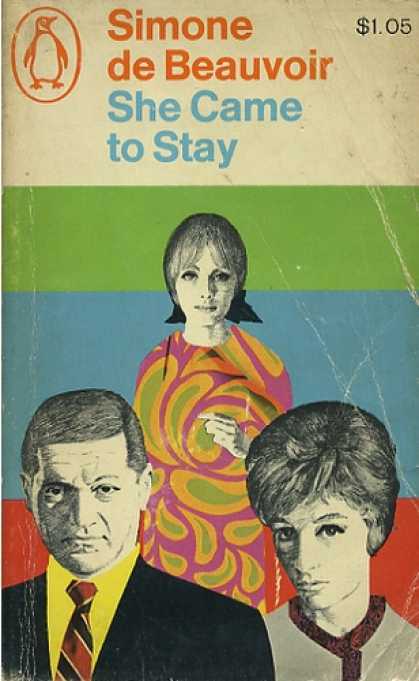
She Came To Stay – Simone de Beauvoir
 READ FOR BOOKCLUB
Chosen by Rachel
☁ She Came To Stay is a novel written by French author Simone de Beauvoir, published in 1943. The novel is a fictional account of her and Jean-Paul Sartre’s open relationship with sisters Olga and Wanda Kosakiewicz. It was written as an act of revenge against the women, who nearly destroyed the author’s relationship with the celebrated philosopher.
Set in Paris on the eve of and during World War II, the novel revolves around Françoise, whose open relationship with her partner Pierre becomes strained when they form a ménage à trois with her younger friend Xaviere. The novel explores many existentialist concepts such as freedom, angst, and the other.
All she had to do was make the simplest of gestures — open her hands and let go her hold. She lifted one hand and moved the fingers of it; they responded, in surprise and obedience, and this obedience of a thousand little unsuspected muscles was in itself a miracle. Why ask for more?
It is a decadent story where everything is available and life is for living. The characters are the sole drivers of their lives and their futures, so there is a lot of dialogue and relationship building. This style divided the freerangers, with some relishing the true-to-life structure and others being driven to distraction by the intensity and the constant chatter. Whatever the case, it’s definitely a unique novel.
—–
Published 1949
Secker & Warburg
416 pages
White Noise – Don DeLillo
 READ FOR BOOKCLUB
Chosen by Sophia
A satire in which Jack Gladney and his family endure an airborne toxic event after an industrial accident
☁ “Jack Gladney is a professor specialising in Hitler studies who is consumed with the idea of his death. His fourth wife Babette and his four children lead mundane lives, spending pages performing everyday tasks in a typical Californian town.
Before the mundanity gets too much there is an event which shakes the family: the airborne disaster of Nyodene Derivative that invades their town and forces their evacuation. Jack’s previous obsession with death is justified as all the family face their own mortality in different ways.
Life and death are the central themes of the book and are treated philosophically. Jack, Babette and the children glean much information from media and books and freely discuss topics and and ideas that might be considered unusual for a typical American family.
Only a catastrophe gets our attention. We want them, we depend on them. As long as they happen somewhere else. This is where California comes in. Mud slides, brush fires, coastal erosion, mass killings, et cetera. We can relax and enjoy these disasters because in our hearts we feel that California deserves whatever it gets. Californians invented the concept of life-style. This alone warrants their doom.
The book is full of excessive consumerism, conspiracies and family woes in a tone that we felt almost normalises fear and disasters. We were reading into every sentence and coming up with various meanings. Even the title is perfect, relaying the everything but the nothingness that is poignant to people living in fear. Despite its serious subject matter, the satirical, post-modern style gave it a light-hearted feeling, as did the characters who had many thoughts and opinions, some logical, some crazy, but nonetheless ideas which were easy to connect with.
—–
Published 1985
Viking
326 pages
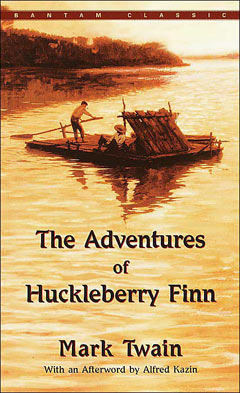
Huckleberry Finn – Mark Twain
 READ FOR BOOKCLUB
Chosen by Suzy
A young boy named Huck sets off down the Mississippi River on a raft in search of freedom and adventure
☁ Inspired by many of the author’s own experiences as a riverboat pilot, this book tells the story of two runaways — a white boy and a black slave — and their journey down the mighty Mississippi River. Among their adventures are encounters with a family involved in a feud, two scoundrels pretending to be royalty, and Tom Sawyer’s aunt who mistakes him for Tom.
Although it is now regarded by many as one of the greatest literary achievements America has produced, when the book was first published it scandalised teachers and parents who thought it would corrupt young children with its depiction of a hero who lies, steals, and uses coarse language. Even more recently, the condemnation of the book has continued due to the use of ‘N’ word and it continues to appear on schools’ banned lists. At at the same time it is praised for its strong point of view, skilful depiction of dialects, and confrontation of issues of race and prejudice.
Right is right, and wrong is wrong, and a body ain’t got no business doing wrong when he ain’t ignorant and knows better.
Before this bookclub meet, most of our last readings of Huck Finn was as a child and left only happy memories. With this re-read however, it was the terrible racism that stood out to us. Though it’s important to remember Twain was highlighting an issue of the time and not expressing his own opinions in the writing of this story. The seriousness of the story but also the carefree humour were more evident this time around, and we all felt a new connection to the book.”
—–
Published 1884
Chatto & Windus
366 pages
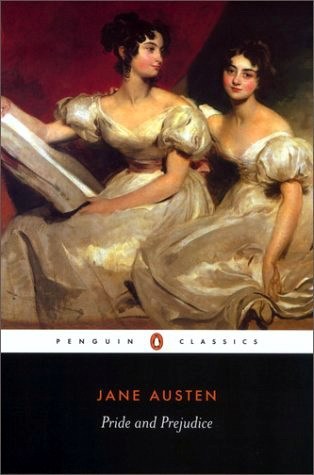
Pride And Prejudice – Jane Austen
 READ FOR BOOKCLUB
Chosen by Jo
A classic that tells the story of Mr Bennet’s five unmarried daughters and the events that unfold when Mr Bingley and Mr Darcy move to town
☁ “Pride & Prejudice was written off and on over more than 15 years before finally being accepted for publication in 1813. Featuring a story of social manners among 18th Century gentries, Pride & Prejudice was the most popular of Austen’s works.
In it, the Bennetts fret over the fate of their five unmarried daughters. For if Mr Bennett dies before any marry, the property and his assets will transfer to a male relative leaving his wife and daughters homeless and penniless. In the opening pages the Bennetts are pleased to hear of that a ‘gentleman of fortune’ has moved to a nearby estate.
It is a truth universally acknowledged, that a single man in possession of a good fortune, must be in want of a wife.
The gentleman, Mr Bingley is introduced to the Bennetts along with his friend Mr Darcy. The daughters are paraded infront of them, social gatherings are held, romance is encouraged, and as expected there are many dances, proposals, love interests, miscommunications, rejections and get-back-together agains.
Though produced in the Romanticism era the youthful passion usually strewn about the pages are more restrained in this example of the genre. Instead Austen emphasises a balance between reason and emotion and therefore a contrast between the expected and what eventuates.
The story primarily focuses on Catherine Bennett and Mr Darcy, the latter who assumes a lack of money or social status disqualifies people from marrying or finding love. However Elizabeth is a keen observer of people and makes it known to her suitor that everyone, irrespective of their status or their flaws deserves love, clearly demonstrating that the two major themes of the novel make up the book’s title.
By you I was properly humbled. I came to you without a doubt of my reception. You showed me how insufficient were all my pretensions to please a woman worthy of being pleased.
The freerangers had all read, partially read or watched TV adaptations of this classic, but it was nice to read it together and delve a little more into it. It’s easy to roll the eyes in regards to the gender stereotypes way back when, but it was refreshing to realise that the author was acknowledging societal bias in some way.
—–
Published 1813
T. Egerton, Whitehall
228 pages

We're
currently
reading
 The Free-Range Bookclub
Recent Comments