The Free-Range Bookclub
Bookclubbers without boundaries in Nelson, New Zealand
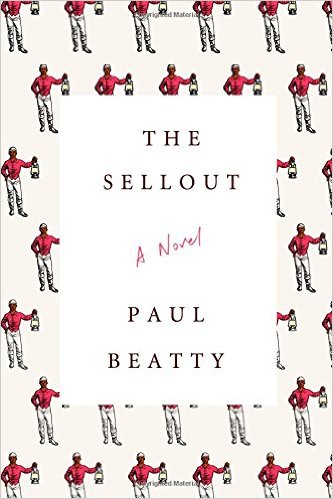
The Sellout – Paul Beatty
 READ FOR BOOKERTHON
In a bid to reinstate his hometown on the map, the narrator in this American satire initiates the most outrageous action conceivable: reinstating slavery and segregating the local high school which lands him in the Supreme Court.
➤ “I honestly started this book with an open mind. It’s “One of the 10 Best The New York Times Book Review Books of the Year” for crying out loud, I was sure I was literary enough to love the hell out of it.
“Undoubtedly there were some genuinely funny moments, but I was so shocked by so much of the “satire” it was hard to fully appreciate these.
“What’s next, a book about the hysterically funny aspects of rape? A satirical take on the gut-wrenching events at Parihaka? By the end of the book I appreciated what I believe the author was attempting to convey, but I think his was ultimately a lazy approach as all he really did was rake through modern-day America’s most disturbing and worrying events and take the piss out of them.” – Suzy
I’m so fucking tired of black women always being described by their skin tones! Honey-colored this! Dark-chocolate that! My paternal grandmother was mocha-tinged, café-au-lait, graham-fucking-cracker brown! How come they never describe the white characters in relation to foodstuffs and hot liquids? Why aren’t there any yogurt-colored, egg-shell-toned, string-cheese-skinned, low-fat-milk white protagonists in these racist, no-third-act-having books?
➤ “When I saw the words American satire on the back cover my heart dropped a little. My brain is wired more towards British satire than the American version. And yes I did end up struggling with the “humour”, despite the author’s message being clear.
“The Sellout is full of satirical digs at society, demonstrating how, in the US at least, racist attitudes are alive and well. I did nod and ahem and even chuckle occasionally. The local paper has black pages with white text; the narrator is referred to only as ‘me’; an unemployed man advertises himself as ‘pre-owned negro slave, only beaten on Thursdays’. Yes, message after message after message, often with frank and cutting language and insults that were difficult to digest. This was an intense book. Obviously Beatty felt it needed to be this jarring to accurately portray the climate of fear he was after. I understand why he felt the need to write such a book but it wasn’t a favourite for me.” – Rachel
—–
Published 2016
Farrar, Straus and Giroux
304 pages
The Story Of A New Zealand River – Jane Mander
 READ FOR BOOKCLUB
Chosen by Rachel
Englishwoman Alice Roland and her children join her colonial husband to live in isolation in Pukekaroro, a settlement on a New Zealand river abutting a native kauri forest.
The biggest cause of her uneasiness was that she had begun to question the verities. If you live beside a river sooner or later you have to. You can’t help sitting beside it, and listening to it, and watching the water go by. And then you wonder idly where all the water comes from and where it goes, and when it began to run and why, and if it will ever end and why. And your thoughts run with it and change with it. And you go out at night to look at the stars reflected in the dark depths of it, and then you look up at the stars themselves, and you ask when and why again.
➤ “In creating The Story Of A NZ River, Jane Mander has plucked a well to-do British family out of old-England and deposited them into the middle of a dense New Zealand karui forest! The cast of characters in this micro community cover the gambit of personalties and societal class and manage to address many political, moral and social issues of the time. I say address but I mean break the rules of! Mander’s characters have a freedom that the 1920s did not afford society, especially women. Yet, amongst the long hard days of saw milling, Mander demonstrates that passion, forbidden love and loyalties have no geographical boundaries, and she creates a nice juxtaposition of the pious English romance against the trials of a colonial settlement, reminding us that opposites attract. It was disappointing no Māori faces graced the pages of this New Zealand book, but this was probably a fact true to point in the lives of many settlers. The author’s own experiences have helped provide an education on colonial life, and the characters are captivating, especially the daughter Asia – once I turned that last page, I found myself longing for a sequel!” – Rachel
➤ “A very well written, literary Mills & Boon is how I would describe The Story of a New Zealand River. Needless to say I was hooked within a few pages! I loved the way author Jane Mander described the tensions and passions between characters, as well as the romance of the rugged yet beautiful New Zealand landscape and the early settlers as they fought to make a living. There were a few notable exceptions from the script of a classic romance: Asia, the daughter of the female lead Alice, was the true heroine. And an undercurrent of feminist, social and political commentary kept it from being a lightweight read. It was easy to see how the book became controversial within New Zealand, at the time it was written. And I loved every minute of it.” – Sonya
➤ “Jane Mander is an absolute master in describing social interactions and the setting in an incredibly precise way. I felt as if I was there – I could picture the bush, the house, the river and I felt the awkward tension between many of the characters (who were all so well developed). It was slightly irritating how perfect and a bit condescending David Bruce was towards Alice but perhaps accurate for the time with regards to male-female relationships. I really enjoyed this book – a beautifully written story.” – Jo
—–
Published 1920
John Lane (New York)
318 pages
The Godwits Fly – Robin Hyde
 READ FOR BOOKCLUB
Chosen by Jo
The Godwits Fly vividly evokes the complexities of family life and the intensely felt world of Eliza, a single-minded young woman in 1920s Wellington. Eliza has affairs and a breakdown and turns to writing for meaning. Like the Godwits, which migrate from Siberia to New Zealand every year, she wishes to escape and see the world. Strongly autobiographical, The Godwits Fly was published in 1938 and has become a New Zealand classic.
We take things too hard and we’re too ignorant. It’s ignorant to love so much and in this wasted way. And we fight, instead of trying to save one another.
➤ “I found this book very difficult to concentrate on and wondered if it would have been better suited to a very slow absorption rather than my relatively rushed read. The writing is very poetical and required analysis – something for which I am not able to give at this time. Depressing but interesting themes abound and once I found out more about Robin Hyde I came to appreciate the novel more as I discovered it is largely autobiographical. That for me was where the true interest lies. Not a favourite I’m afraid as I much prefer a straight forward easy to read book, at least for now anyway!” – Jo.
➤ “I am not going to tip toe around it. I really struggled with The Godwits Fly. This could be quite simply because it is not a book you read at night before going to sleep, when you’re busy or tired. Or it could be because my reading “fitness” is a bit deficit. Either way, the detailed, often poetic prose was tiresome. I struggled to get into the characters, and found myself reading whole chapters without really knowing what was going on, except for a strange melancholy. A sadness. Understanding the author and her personal circumstances helped to place this. And in another lifetime, I would like to go back to it and read it with the attention and deliberation it probably deserves.” – Sonya
➤ “This is the kind of book I love: Kiwi lit, a highly personal story that doesn’t tip toe around societal issues and emotions, and written as if poetry, so that every sentence is rich and beautiful. So why didn’t I connect with it? I certainly did in parts, but in others I managed to miss the relevance of pages of prose. I can only put it down to time, or lack thereof and therefore an inability to truly appreciate every word. And I think this is what this book requires because when I did connect with it, I was engrossed, emotional engaged and relished the mellifluous writing style.
“Despite the time that has passed since its publication I felt the themes and ideas were still relevant for NZ women, for NZ children, and for all Kiwis, especially that of the impulsive need to respond to the call of the motherland. I respect this book for what it means to New Zealand literature but don’t feel that I have completely appreciated it yet. Sophia sold me on the concept of this book many years ago and I have been waiting for so long to find time to read it, so am disappointed in myself for not giving it the time it deserves. I plan to re-read it in the near future and hope that I fall in love with it like so many others have.” – Rachel
—–
Published 1938
260 pages
Infinite Air – Fiona Kidman
 READ FOR BOOKCLUB
Chosen by Sonya
A novel about the enigmatic Jean Batten – New Zealand’s, and one of the world’s, greatest aviators
➤ “I was quite excited by the idea of The Infinite Air. I have heard a lot about author Fiona Kidman, and love a good biographical yarn, especially about brave and enigmatic women. Jean Batten certainly was a woman of extraordinary talent and courage. She was blessed with good looks and brilliance of mind, which coupled with tireless support of her mother and blind ambition, saw her become aviation history. Kidman’s account of her life was indeed fascinating. However, I felt oddly disappointed by the book. Perhaps I was thrown by the genre of biographical fiction? I struggled to feel connected to Jean Batten in the way one might with a fictional heroine, and at the same time I couldn’t quite believe her as a real person. I wanted to be inspired and uplifted by her, but found myself feeling sad for the cost and consequence of the choices she made to achieve what she did.” – Sonya
➤ “I really felt like I was getting an education on Jean Batten while reading this book which is very satisfying! I think Fiona Kidman gave an empathetic portrayal of someone who perhaps would have created some derision at the time, for example with her perceived using of men for money (it seems to me though that she paid a price for the money she acquired!). There were interesting mentions of famous people peppered throughout the story which I found intriguing. It seems that Jean Batten had a bit of a tragic life with regards to relationships and family however she stood out to me as an incredibly admirable woman for her huge amount of ambition and determination and of course amazing success. This success was amplified when you consider the age, oppression and usual dependence of women on men at the time. A fantastic life made into an easy to read, well written story.” – Jo
➤ “Shamefully, I did not know much about Jean Batten so I relished the opportunity to read this biographical fiction book about her life. It is a truthful story about the passion of the woman who was determined to break aviation records all over the world. I was astonished at her resolve and how easily she (seemed to) achieve things that most of us would never consider possible. Kidman has done a superb job of capturing this spirit and determination and ensuring Batten comes out of it as a person, not a character. I loved this book from start to finish and am so pleased Batten’s life has been documented for future generations.” – Rachel
—–
Published 2013
Random House
352 pages
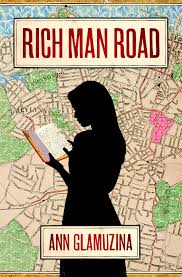
Rich Man Road – Ann Glamuzina
 READ FOR BOOKCLUB
Chosen by Becks
Olga and a misunderstanding travel from her war-torn Dalmatian village through WWII, refugee camps and into her new life in Aotearoa. Pualele arrives in 1978 from Samoa via an illegal family adoption and lives life as a Pacific Island overstayer. Both become nuns in New Zealand and when their paths cross they are encouraged to reveal their stories and secrets to one another.
➤ “There was something about Rich Man Road that had me captivated early on. Perhaps it was the war theme? (I love a good war story.) Or the Dalmatian landscape? (I have spent time there and it is a captivating coastline). Or the sense of mystery we get in revealing two Nuns’ stories? Or maybe it was quite simply the brilliant story-telling ability of Ann Glamuzina. Whatever, I loved it. It was not a happy story, at times depressing and saddening, but at its conclusion I was left with a profound sense of optimism and hope. Definitely one of my favourite reads, read at speed and with enthusiasm (a sure sign of something worthwhile).” – Sonya
➤ “This is a sad story of love and loss and an enthralling read. I thought that the Dalmatian and Samoan cultures were portrayed well (from my limited knowledge anyway) and Pualele and Olga were well developed characters. Olga’s emotional estrangement from her mother was incredibly sad to me and so difficult to read about – her mother seemed so cruel. Pualele was often misunderstood which was frustrating and I wanted to shake her into standing up for herself! The vagueness surrounding their tie at the end of the book was frustrating and a little confusing. I enjoyed this book but perhaps not enough to recommend it.” – Jo
➤ “Rich Man Road is a tightly woven story. Of lives intersecting. Of the struggles of impoverished immigrants. Of the desperation to find a place to call home. The characterisation is rich – I remember Olga and Pualele as if they are real people and I worried about them and their plights inbetween reading sessions. Not only were their characters strong but their stories enthralling and woven together like they were, made for a wonderful page-turner. The sense of time and place was well constructed also, leaving me with visual memories of the stories. My only criticisms would be that the introduction of the hidden diary from the outset felt a little to convenient, and I thought the conclusion was too sewn up. But all in all, this is a book that would appeal to a wide range of readers.” – Rachel
—–
Published 2015
Eunoia Publishing
256 pages
Wake – Elizabeth Knox
 READ FOR BOOKCLUB
Chosen by Jo
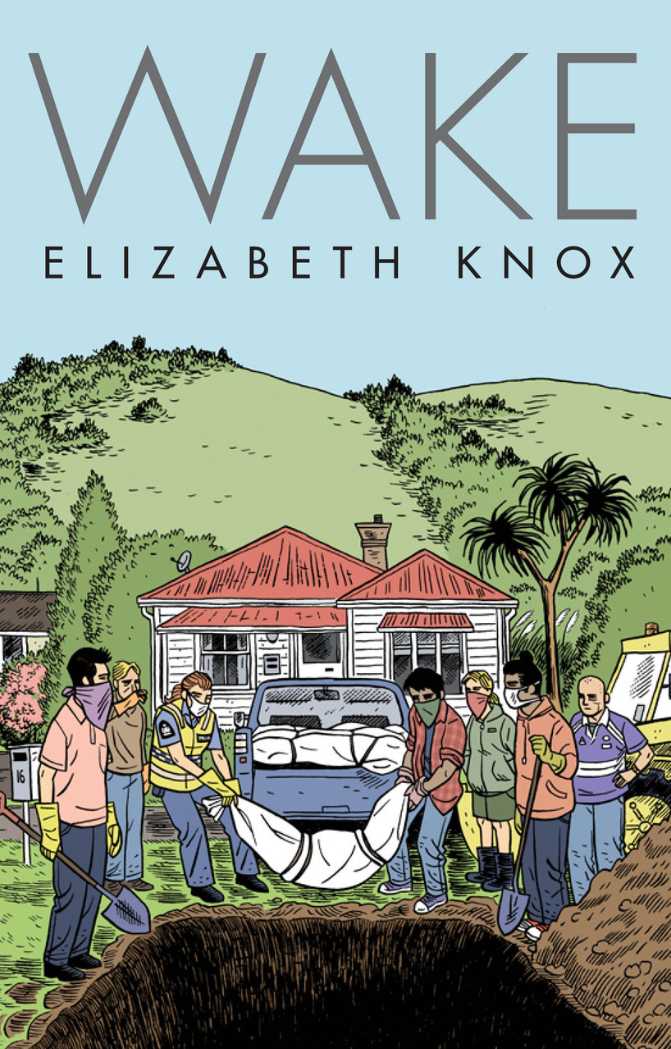
One sunny spring morning the Tasman Bay settlement of Kahukura is overwhelmed by a mysterious mass insanity. A handful of survivors find themselves cut off from the world, surrounded by the dead. As they attempt to care for one another and to survive, they discover they are trapped with something the defies definition.
➤ “The horror scenes at the beginning of this book were told bluntly and with little emotion – very matter of fact and almost comical with the personally relevant ways in which people died. The psychological interest for me was piqued with the longer story of survival and thinking about the future – I often pondered how I would have coped in the same situation.
“The monster was mysterious and faceless which enabled the story to become so much more than when the horror is known. I’ve always felt a sense of disappointment or that the monster was ridiculous when revealed in other books but this story retained its power with some details but not all, of this particular monster. I felt like I knew the characters at the end and was totally enthralled with the whole story. Another great novel from Elizabeth Knox.” – Jo
➤ “The undefined nature of the monster is the crux of this book. It’s strange how we want to put a face or a name or provide a reason for the wrongdoing – I certainly did while reading Wake. But it was soon apparent that an explanation wasn’t forthcoming, as happens in life, and so I settled into the story of endurance and survival.
“There was a lot of “reading into” that could be done, and so while it was on surface level a kind of an apocalyptic tale of a monster killing its way across the land and the fight by the good people to save mankind, there was so much more to it. The monster could be any number of demons that people face and the survival mode representative of the means to which any of us could go when in dire circumstances. To add to all this, the book was also spookily comical, with a well constructed cast of characters – it covered all the bases and roused every emotion. A fantastic read.” – Rachel
—–
Published 2013
Victoria University Press
445 pages
The Scarecrow – Hugh Morrieson
 READ FOR BOOKCLUB
Chosen by Rachel
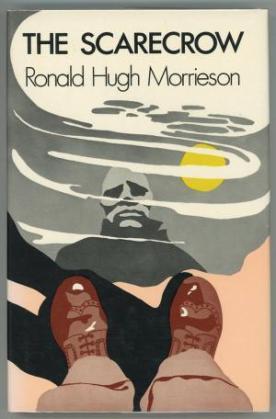
Neddy Poindexter worries about his pretty sister Prudence when it’s discovered there’s a killer on the loose. Part adventure, part small-town comedy and part horrifying thriller, The Scarecrow is classic Kiwi Lit noir.
The same week our fowls were stolen, Daphne Moran had her throat cut.
➤ “The opening line is brilliant and I knew from this point that I was going to love this book. A show of classic NZ literature, a touch of domesticity and the beginning of a thriller all within a few words. I don’t think any other book has captured me so quickly. Neddy is a wonderful protagonist, a true Kiwi boy whose humility and kindness keep our heads above water as we traipse through the horror. And some truly horrible things do happen, but it’s strange how upon completion, I didn’t dwell upon them, nor was I troubled by them. In my opinion it was the construction of the lovely Neddy that kept me smiling through the horror. If you value NZ literature, I’d suggest this should be top of your reading pile!” – Rachel
➤ “I have to say, The Scarecrow was a bit of an ‘icky’ read. Its sordid, sexual content and the griminess of the poverty and alcoholism portrayed made me feel uncomfortable. Could small-town New Zealand really be so sickly and dark in the 1950s? What sort of person would write such a thing? Yet, at the same time, it was an astonishingly clever read! Morrieson drew me in with his vivid descriptions of places and events, and cleverly painted characters. It was a book peppered with unexpected humour, of hope, and of the tenacity of human spirit in the face of adversity. In the end, it shaped up to be one of my favourite (or at least most memorable!) bookclub reads so far.” – Sonya
➤ “This book had me hooked from the start with its fantastic opening line – it truly is one of the best. The disturbing topic matter is numerous with murder, necrophilia and alcoholism just to name a few however I never actually felt disturbed as the writing wasn’t graphic or gratuitous. The main character was endearing and the others well developed – uncle Athol was particularly horrid as well as the Scarecrow himself, the physical description had him sounding utterly repulsive. Some blackly humorous scenes peppered the book and released tension. I thoroughly enjoyed this book and felt that the disturbing themes added to its interest. All up a great NZ book.” – Jo
—–
Published 1963
Angus & Robertson
240 pages
2016 NZ Book Awards
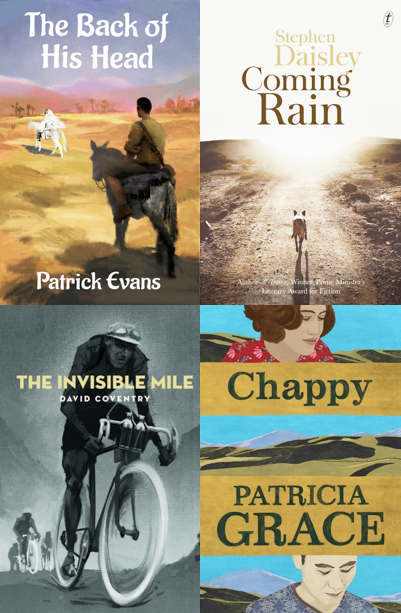 There was a lot reading that could have been done this year, a lot of reading we wanted to do, but alas, there isn’t time for everything!
So, we read what we could and that included the fiction section and a few of the non-fiction. Here are our mental wanderings:
➤ “Of the four fiction shortlisters my favourite read was Coming Rain by Stephen Daisley. I was able to completely immerse myself in the storylines and the beautiful language created vivid scenes that activated all the senses. Do I think this novel will necessarily win…?
“I enjoyed all of the books on the shortlist however it seems the most hype surrounds The Invisible Mile – therefore I think David Coventry will take it out by a bike length.” – Suzy
 ➤ “A varied shortlist, where each contender has a unique feature. Chappy is very much a NZ book, The Invisible Mile a Kiwis-take-on-the-world story, Coming Rain is the most sensory, while The Back Of His Head was the cleverest (in my humble opinion).
“I did enjoy them all but Coming Rain struck something in me that the others didn’t so I’m pinning my hopes on Daisley.
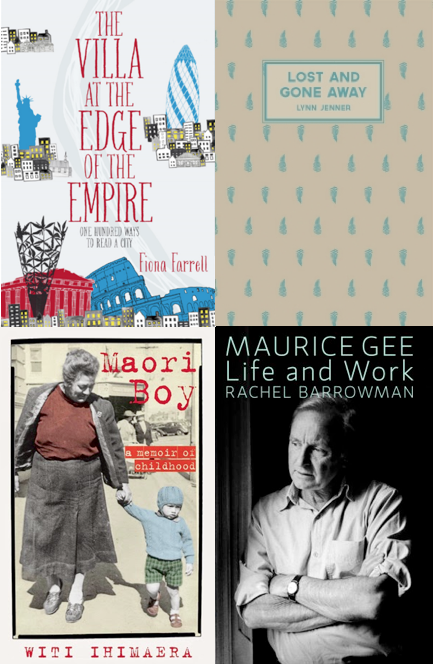
“As for the non-fiction section, I didn’t make it to all four contenders so my comments are perhaps irrelevant but, hey, that hasn’t stopped me before! So I have to say Maurice Gee’s biography impressed me immensely so I’m keeping my fingers crossed for Barrowman.”– Rachel
Best book 1st-4th: Rachel:
Coming Rain
Chappy
The Back Of His Head
The Invisible Mile
Best book 1st-4th: Suzy:
Coming Rain
The Back Of His Head
Chappy
The Invisible Mile
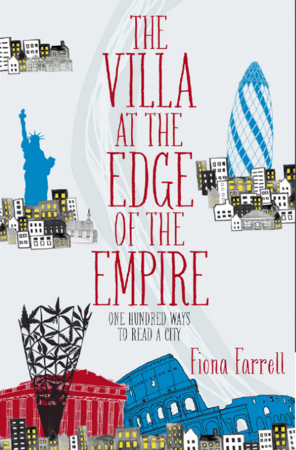
A Villa At The Edge Of The Empire – Fiona Farrell
 READ FOR NZ BOOK AWARDS
A book which examines the evolution of cities and of Christchurch in particular after its destructive earthquakes.
➤ “Prior to reading I thought this would be an important book to Cantabrians, but now I see this is a book relevant to all. Yes it does detail Christchurch’s history, it’s pre and post earthquake status, how and why the city was mapped out and the consequences of that decision making. But it also examines the stories of other cities around the world that have seen disaster and destruction and puts our broken city up there in comparison and in reverence as it rebuilds.
“But there’s more to it than the nuts and bolts of the facts. Farrell not only details her own personal journey through the Christchurch earthquakes but addresses the collective story of Canterbrians and, yes that can sometimes seem over-political, but who am I to say that was not the consensus of the people at the time.
“The book also reports on social aspects that affect a city after destruction. As she says, ‘an earthquake is not simply a geological event. It occurs within a specific social and political context.’ And she’s right. When something happens is of consequence to the aftermath. Who’s in Government does have an effect. There is much to ponder.
“A fantastic book for those who want to consider more than what they see in media coverage of disaster events.” – Rachel
—–
Published 2015
Vintage
326 pages
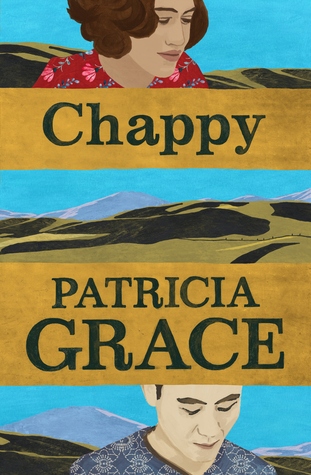
Chappy – Patricia Grace
 READ FOR NZ BOOK AWARDS
“A deserter of the Japanese army stows away on a ship to New Zealand at the onset of WWII. Known as Chappy, he remains in the country illegally and marries a Māori woman. Decades later his grandson wishes to learn of his history, including the intolerance, cross-cultural conflicts and desire to belong he experienced. As a result many family secrets are unearthed.
➤ “There is a wandering spirit about this book which transcends the family secret, but mimics the journeys of our ancestors, and the paths we travel to come together as family.
“Told through interweaving narratives, in (translated) Maori, Japanese and English, the characters in Chappy each bring their part of an international story, one that details the Maori story but also its place amongst the stories of others. There is no doubt this is a New Zealand story – it has mana; it is a story that relishes whanau and belonging.
“The multi-narration style takes a little getting used at the beginning but soon after I eased into it and found it did not disrupt the plot lines. This book is also a fascinating example of some of the untold stories of war, and the surprises keep coming right until the end.” – Rachel
➤ “Patricia Grace’s (Ngāti Toa, Ngāti Raukawa, Te Āti Awa) Chappy is a heartwarming and heartbreaking love story. As much as I enjoyed the novel there were times when the characters felt one-dimensional and I found myself hungry for more information on their motivations and also the setting they were in.
“Perhaps this was due to the story being a retelling of past events rather than being ‘here and now’. Also of course we do not hear directly from the lovely Chappy and instead have an interpretation of his life from those close to him.
“This is my first Patricia Grace novel (shame on me) and despite not fully connecting with the writing I would like to read more of her work so I can gain a greater sense of her style.” – Suzy
—–
Published 2015
Penguin Books
256 pages

We're
currently
reading
 The Free-Range Bookclub
Recent Comments