The Free-Range Bookclub
Bookclubbers without boundaries in Nelson, New Zealand
All Our Yesterdays – Natalia Ginzburg
READ FOR BOOKCLUB
Chosen by Jodie
Published in 1952 and set against the rise of fascism and the Second World War in Italy, All Our Yesterdays explores how history unfolds through ordinary lives rather than extraordinary events. Natalia Ginzburg examines family, love, duty and the compromises people make as the world around them drastically changes.
He told her that up till that day she had lived like an insect. An insect that knows nothing beyond the leaf upon which it hangs.
Click the arrow to read each person’s full review
JODIE: Beneath straightforward language is an enormous amount of emotional depth — stayed with me long after I finished it — during tragic or difficult moments, there is often a subtle comedic edge 3.5⭐️
Natalia Ginzburg’s All Our Yesterdays is a novel that stayed with me long after I finished it. What I enjoyed most was her style of writing. It’s plain, direct, and completely free of unnecessary drama, yet it manages to convey so much emotion. I also loved her dry humour. Even during tragic or difficult moments, there is often a subtle comedic edge that feels very human and true to life.
Ginzburg’s writing is simple and understated, which is something I really appreciate. Rather than focusing on heroic events or larger-than-life characters, she writes about ordinary family life, relationships, and the small decisions that shape people’s lives. The story unfolds against the backdrop of wartime Italy, but the focus remains firmly on the everyday experiences of her characters.
Some readers may find her style too simple, but I think that’s where her strength lies. Beneath the straightforward language is an enormous amount of emotional depth. She captures loneliness, love, disappointment, and resilience with remarkable honesty. The emotions are never overstated, which somehow makes them even more powerful.
For me, All Our Yesterdays was a thoughtful and deeply moving novel that demonstrates how much can be said with seemingly simple prose.
RACHEL: Initially … I felt one step removed from the action — authentic portrayal of Italian war life — particularly liked the last section where the pace heightens 3.5⭐️
As a fan of Ginzburg’s novellas I was keen to read one of her full length novels. All Our Yesterdays has the same rolling, off-hand, over-the-fence style narrative that feels like someone recounting gossip. In a novella it adds to the snappy, fragmentary style revelations that keep the pace and intrigue up. Initially, I wasn’t convinced it worked as well in a full length novel. I felt one step removed from the action, like I wasn’t in the midst of it observing everything first hand.
But as the war setting intensified and people’s lives became a series of hurried conversations exchanged on street corners, I began to appreciate how well suited this style was. Life, especially in wartime, changes in an instant and there is little time to ponder, dramatise and eulogise over individual events when your community is under siege. The more I read, the more the book and vast cast of characters grew on me and in the end I felt that All Our Yesterdays was an authentic portrayal of Italian war life. As Ginzburg lived through this time herself it’s no surprise the plot and characters seem so realistic. I particularly liked the last section where the pace heightens and all the hearsay comes to shocking fruition.
BRIDGET: took me a while to start enjoying this one — life-changing events delivered in an almost matter-of-fact way — truly came alive for me once I learned more about the author 3.5⭐️
It took me a while, about halfway through, to start enjoying this one. Natalia Ginzburg’s literal style was initially quite hard to read, mostly because none of her characters actually speak. Instead, the book is written as if someone is telling the story in a gossipy way, a style I have never come across before! On reflection, though, it perfectly suits the feel of the novel. The story is set across several small Italian villages and towns, the exact kinds of places where everyone makes it their business to know what everyone else is doing.
The plot strolls along at a semi-slow pace, introducing the dynamics of the primary family and the family next door. Interestingly, neither family is given a surname; they clearly have them, but Ginzburg chooses not to use them. She also avoids using first names for certain characters, like Anna’s father, who is simply called “the old man,” or Anna’s daughter, who is referred to as “the little girl.” By omitting these names, I never actually formed a picture in my mind of what the characters looked like, which was a unique experience for me as a reader. Despite the slow pace, several life-changing events are delivered in an almost matter-of-fact way. These were the parts I had to re-read just to process the full impact of what was happening. Ultimately, Ginzburg’s vocabulary offers a deeply personal, human viewpoint of this historical era one in which she lived through.
While I enjoyed the book on its own, it truly came alive for me once I learned more about the author herself.
SALLY: felt authentic in that it reflected small-town relationships — whole tapestry of stories, each intertwining with the others — would make a great film 3⭐️
This classic war novel follows two families who live opposite each other in a small town. The cast of characters includes all the family members, their servants, their friends, village luminaries such as the police sergeant and the chemist, the local Marchesa, peasant farmers, refugee Jews and the village cripple. We even have an insight into the thoughts of a disillusioned young German soldier. In short, we see the situation through the eyes of every level of society and political persuasion. Despite many reviews leaning towards the youngest daughter, Anna, as the main protagonist, I didn’t feel there was a main protagonist but rather a whole tapestry of stories, each intertwining with the others and affecting them differently.
As the story progresses, we learn who amongst the characters can rise above the pressures, depravations and loss of war and who crumbles. Perhaps even more moving though, are the characters who neither rise nor crumble but just grind a way through the hell of the occupation and survive.
Ginzberg’s style was off-putting to me at first. She often uses very long sentences, lots of comma breaks and repetition within the same sentence. It’s not that these long sentences are hard to follow, the opposite. The word that came to mind for me was that she was prattling, almost gossiping. A lot of the text sounded to me as if it was being recited over the fence by one nosy neighbour to another. Once I had packaged it like that, it felt authentic in that it reflected the small-town relationships, mentalities and events that are the fibre of the whole novel. Because it was such a rapid-fire style, I did feel she lost the impact that one of the more serious events should have had on me as a reader.
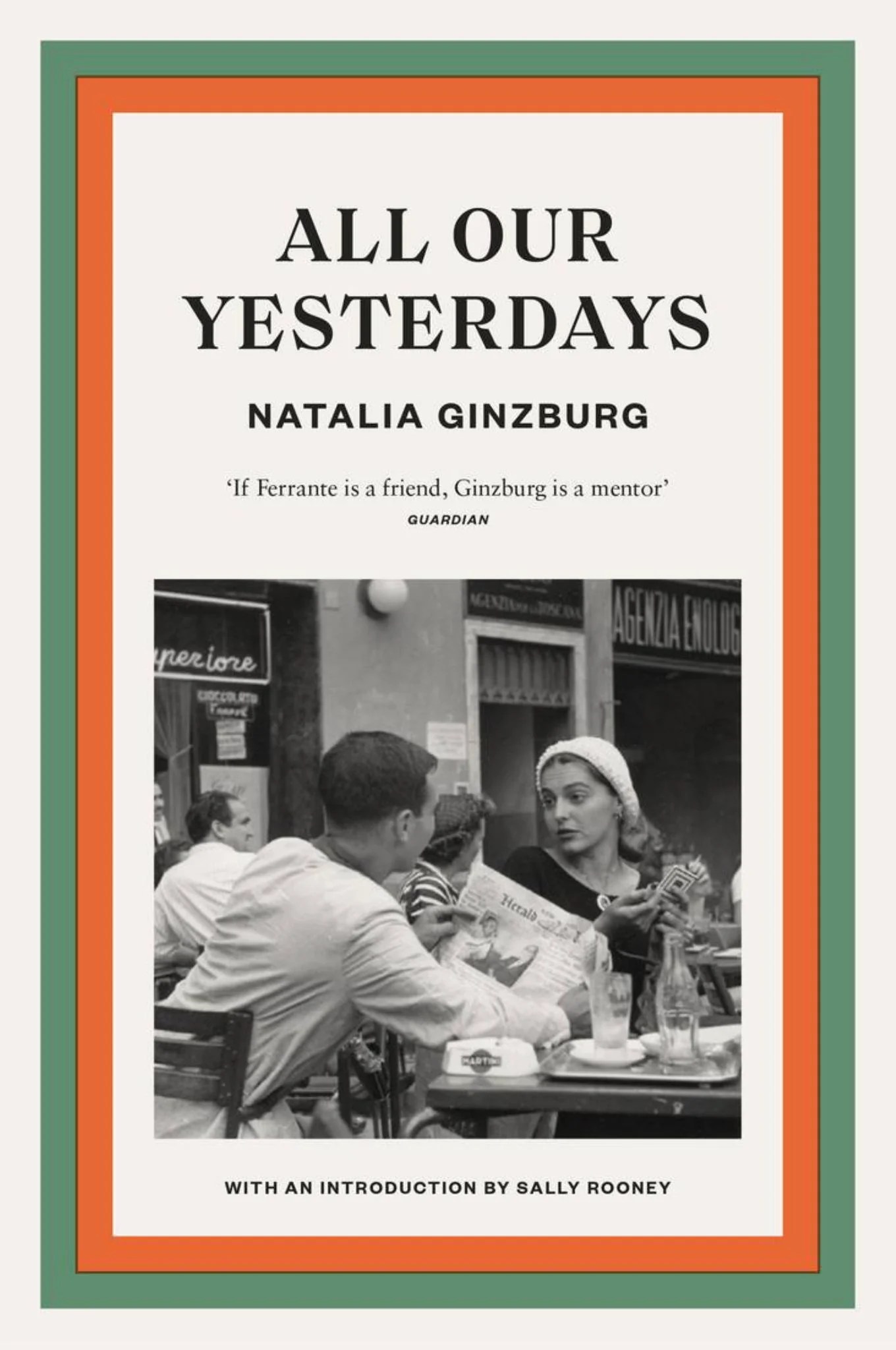
This book would make a great film, and as an aside, my copy of the novel has a fabulous photo on the front by the great American photographer Ruth Orkin. It will be a serious runner for our “Book Cover the Year” award. Titled “Jinx and Justin – Florence 1951”, do yourself a favour and go down a rabbit hole looking up both Orkin and Jinx (real name Ninalee Craig).
TESSA: strength lies in its intimate portrayal of ordinary people — experiences of war do not simply end when peace arrives — felt as though I had lived alongside these families 5⭐️
I absolutely loved All Our Yesterdays and could not put it down. The novel follows the lives of two interconnected families as they navigate love, loss, family tensions, and the gradual intrusion of history into their everyday lives. While the book is undoubtedly shaped by war, fascism, politics, and the major historical events of the period, for me it’s true strength lies in its intimate portrayal of ordinary people.
Ginzburg writes with remarkable sensitivity, capturing the small moments and relationships that define her characters just as much as the larger events unfolding around them. The novel feels deeply human, showing how history is experienced not through headlines and military campaigns, but through families, friendships, marriages, and personal struggles.
The second half of the novel contains some incredibly heartbreaking events as the realities of war arrive on the characters’ doorstep. These moments are handled with emotional honesty and restraint, making them all the more powerful. In particular, Anna emerges as a memorable protagonist. Faced with profound tragedy and disappointment, she demonstrates quiet strength and resilience, adapting to circumstances beyond her control.
What stayed with me most was the way experiences of war do not simply end when peace arrives; they become woven into the characters’ identities and relationships, influencing the lives they build afterwards.
‘And they laughed a little and were friendly together, the three of them, Anna,
Emanuele and Giustino; and they were pleased to be together, the three of them, thinking of the dead, and of the long war and the sorrow and noise and confusion, and of the long difficult life which they saw in front of them now, full of all the things they did not know how to do’.
By the final page, I felt as though I had lived alongside these families and witnessed a significant chapter of their lives. A beautifully written novel which I highly recommend and give a 10 out of 10.
First published in 1952 in Italian
Translated in 1956 by Angus Davidson
Giulio Einaudi Editore
300 pages

We're
currently
reading


Recent Comments