The Free-Range Bookclub
Bookclubbers without boundaries in Nelson, New Zealand
2017 – Hot Genres
 Genres are in accepted abundance these days. Gone are the days when crime, romance and fantasy were about all the classifications local librarians were willing to use. Today, not only are books cryptically catalogued, but classics are gaining new reclassifications too, as their historical significance becomes more apparent.
Existentialism they are branded, magic realism, post modern or meta fiction. A marketing technique or a contemporary realisation that genres, like personalities, are open to interpretation? Every where you look these days, personality types are springing up, perhaps as a way to explain our nuances, or to better understand ourselves. So should a book be any different? Can a slightly modified genre make the novel more genius or is it the same old thing, different wrapping?
At The FreeRange Bookclub we thrive on personality and genre types. And have done so for ten years. Yes! Ten years our nerdy friendships have converged. To celebrate this milestone, all past and present bookclubbers are coming back to where it all started in sunny Nelson for a bookclub reunion. A collection of diverse and delightful personalities required a couple of equally diverse and intriguing books to read and discuss – and we think we’ve found them in J M Coetzee’s The Childhood of Jesus and Sylvia Plath’s The Bell Jar.
The rest of the year will see us take on a range of unique genres to expand our reading, so it seems only fitting that the first two books of the year are ones which are difficult to compartmentlise in a genre category. Do they cover many genres? Or have the authors created their own? Check back in to hear our thoughts.
2017 Schedule
The Bell Jar – Sylvia Plath
The Childhood of Jesus – J M Coetzee
As The Earth Turns Silver – Alison Wong
Invisible Cities – Italo Calvino
Into The River – Ted Dawe
The Handmaid’s Tale – Margaret Atwood
Blindsight – Maurice Gee
East Of The West – Miroslav Penkov
Soul Print – Megan Miranda
Kafka On The Shore – Haruki Murakami
The Hut Builder – Laurence Fearnley
2016 – End Of Year Thoughts

 2016 was New Zealand lit heavy for The FreeRange Bookclub. Not only did Kiwi novels litter the schedule, the NZ Book Awards re-emerged, inciting fresh excitement amongst book lovers about our home-grown talent.
With our immersion into New Zealand books, we discovered there were stylistic similarities and recurring themes in what a local author will produce. The laid-back, retelling of childhood memories is prevalent, invoking the reader’s own reminiscence and bonding with the content – a personalised story rather than a plot heavy, drama filled book like an overseas writer may produce.
At the other extreme, dark, disturbing tales seem to be a part of our literary make up too. Yet, we surmised, they are done with a level of restraint, to ensure intrigue and a level of ickyness are present, while the truly disturbing material is hinted at or camoflagued so as not to be raw and horrifying.
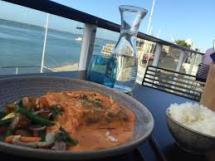
So at Nahm Restaurant, overlooking the Nelson harbour, we mused over our favourite moments of the year. There were some similarities among our favourite moments. For example, the Scarecrow’s opening line was deemed the most memorable sentence: “The same week our fowls were stolen, Daphne Moran had her throat cut.” Elizabeth Knox’s faceless monster in Wake was considered the most thought-provoking metaphor, and the ending in Genesis the most shocking moment. Here’s a few more of our top picks:
Book of the year:
Sonya: Wake
Rachel: The Scarecrow
Becks: The Scarecrow
Jo: The Scarecrow
Runner up:
Sonya: A Story of A New Zealand River
Rachel: A Story of A New Zealand River
Becks: A Story of A New Zealand River
Jo: Genesis
Best couple/romance:
Sonya: Alice & Bruce from A Story of A New Zealander River
Rachel: Charmaine & Stan from The Heart Goes Last
Becks: Alice & Bruce from A Story of A New Zealander River
Jo: Azoro’s mother and father in The Famished Road
Most memorable setting/location:
Sonya: The river in A Story Of A New Zealand River
Rachel: The prison in The Heart Goes Last
Becks: The river in A Story Of A New Zealand River
Jo: Our home region of Tasman in Wake
Book Book – Fiona Farrell

READ FOR BOOKCLUB
Chosen by Sonya
As war is waged in the Middle East, a woman in New Zealand has her nose in a book – part fiction, part autobiography, Farrell documents her life’s history with reading
➤ “I really enjoyed Fiona Farrell’s writing style. So clever, rhythmic yet readable. The anecdotes within her memoir were beautifully crafted. You tell that the words were those of a literary pro. Yet, overall I was vaguely bored. I suppose in simple terms, I like a good made-up story, with a great plot and larger than life characters. This was not that kind of story. Although I didn’t dislike it, I had to make myself read it.” – Sonya
➤ “Book Book was a concept that appealed to me, a self-confessed book nerd: a life (so far) explained through books; and a New Zealand life which might rekindle my own childhood memories, and mention books and writers with whom I’m familiar.*swoon*. And ultimately the book did deliver all that. (Even if an early mention of Farrell’s hometown of Oamaru did not turn into a Frame commentary until page 293.) However, while I did enjoy the individual moments, ultimately the book ended up as a collection of interesting stories without any of the usual climax associated with fiction. A nice read, but not exciting.” – Rachel
➤ “Book Book is a nice, easy-to-read book with lovely nostalgic New Zealand references peppered throughout. There are frequent references with excerpts to various books and authors and I struggled at times to see the relevance of these – perhaps a failing on my part. Although pleasant to read there weren’t any great highs or lows and I was left feeling underwhelmed at the end. A tad ho hum for me I’m afraid.” – Jo
—–
Published 2004
Vintage Books
364 pages
The Famished Road – Ben Okri
 READ FOR BOOKCLUB
Chosen by Becks
In this 1991 Booker winner, the narrator, Azaro, is a spirit child struggling between the tensions of the living and the temptations of the carefree spirit kingdom.
We must look at ourselves differently. We are freer than we think. We haven’t begun to live yet. The man whose light has come on in his head, in his dormant sun, can never be kept down or defeated. We can redream this world and make the dream real. Human beings are gods hidden from ourselves.
➤ “Set in an unnamed city in Nigeria, this novel employs a unique narrative style incorporating the spirit world with the ‘real’ world, which some classify as magical realism. This book exploits the belief in the co-existence of the spiritual and material worlds that is a defining aspect of traditional African life. An enchanting book at first but after a while the fantasy scenes began to repeat themselves. Very quickly things stopped feeling strange or astonishing and I felt like I was going over the same ground again and again. This is a book in which hardly anything occurs.
“Described as having ‘dreamlike’ prose, for me it was a nightmare that tested my patience. Magical realism is perhaps not the genre for me!” – Becks
➤ “The Famished Road is an enthralling title and one which not only draws the reader from the outset but sums up the content well, especially the themes of travelling and hunger. The main character Azaro is a spirit child not only travelling between reality and the allure of the spirit world but also life as a son in an improvised community; while characters hunger for many things, food, power, money, independence.
“The plot is original and particularly interesting once the father and son’s relationship strengthens. However, its robustness is often drowned out by Azuro’s many visions and interactions with spirits. While they do support the plot they distracted me with their length and complexity. I am a fan of magical realism but this was a step further than the magical realism I am used to.” – Rachel
➤ “The premise of the spirit child in The Famished Road drew me right in at the start and I was looking forward to reading this book, however the long drawn out and often incomprehensible dreams or spirit journeys became a bit tedious. The Famished Road is a book full of misery that somehow failed to make me sad as the characters situation all seemed a bit distant with no real emotional connection for me. Some of the characters were well defined and I particularly liked the father and Madame Koto. Not a book I would recommend to a friend.” – Jo
—–
Published 1991
Anchor Books
512 pages
2016 Bookerthon
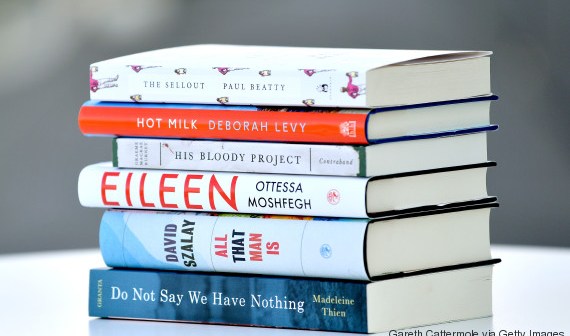 In a year in which many established authors and their highly anticipated books (McEwan, Coetzee, Barnes, Tremain to name a few) didn’t make the shortlist, nor the longlist some of them, we were expecting big things from the 2016 Man Booker. We hadn’t even heard of some of the authors but thought we must be in for a treat for them to oust some of our favourite writers.
However, prior to coming together we had both stated we felt a little underwhelmed by the shortlisters we had read so far. Perhaps our expectations were too high? Perhaps our views were stymied about what a Man Booker shortlister should be?
 To figure it all out, we met in St Arnaud, the perfect hideaway for completion of our reading, conversation and blogging.
As we read more what we saw emerge was a body of work that was certainly not what we expected, but one which was pushing boundaries on the traditional form of the novel. A short story collection that is really a novel, a novel purporting to be true crime, a significantly historical novel presented in a contemporary format, a heavily satirical novel which the author says is certainly not satire, a dense character study that is almost plotless – this is the generation of anything goes and it is reflected in these, the best books of the year.
The contrasting novels from several different genres are outstanding examples of what can happen with a free-range mind! Yet amongst the risk-taking was a consensus for clear story-telling and message provision. There are few limitations on who could read and enjoy these books.
Suzy sums it up, saying: “This is easily my favourite Bookerthon in years. 2016 has been a wonderfully plot-heavy collection of books that have all challenged and moved me in ways that has had me completely in awe of the authors’ talents. I have read books I wouldn’t normally be drawn to, but have absolutely loved. From 1860s Scottish highlands to 1980s China, not only have I been entertained but I also feel educated about aspects of society that I was otherwise ignorant about.”
So, with the advantage of hindsight, discussion and all the reading completed, here are our final thoughts.
Hot Milk was the most readable; All That Man Is provided a captivating take on the human psyche, in a unique novel/short story/novel kind of way.
The Sellout was demanding to read but that’s what made it complex and one-of-a-kind. If the author insists it’s not satire, has he created a whole new genre?
While at first it seemed the author of His Bloody Project was treating the reader like a fool, it turns out he was treating us with the utmost respect, and Eileen was a roller coaster ride of emotion and wonderment.
However, the shortlister that nudged ahead of the others for us both was the historically significant and meticulously researched Do Not Say We Have Nothing by Madeleine Thien. It was a novel designed to shock and move the reader with characters who live beyond the page. That Chinese history, music composition, complex mathematics, literature, love, loss and friendship can be written about in a universal and contemporary way, so that nobody is excluded from enjoying it, is a feat. And therefore it becomes our pick for the 2016 Man Booker Prize.
Rachel’s favourites 1st-6th
Do Not Say We Have Nothing
Eileen
His Bloody Project
All That Man Is
Hot Milk
The Sellout
Suzy’s favourites 1st-6th
Do Not Say We Have Nothing
Eileen
His Bloody Project
All That Man Is
The Sellout
Hot Milk
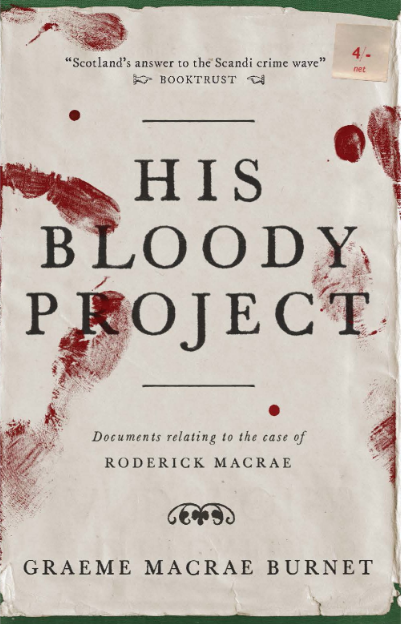
His Bloody Project – Graeme Macrae Burnett
 READ FOR BOOKERTHON
Roderick Macrae admits to a triple murder in a remote Scottish community in 1869. A memoir written by Macrae makes it clear he is guilty but it’s up to the police and courts to try and uncover his motive.
A memoir written by the accused makes it clear that he is guilty, but it falls to the country’s finest legal and psychiatric minds to uncover what drove him to commit such merciless acts of violence.
➤ “So, a crime story is shortlisted for the Man Booker. A crime story disguised as true crime no less.
“Burnet purports to have discovered a document penned by a distant forefather revealing all about why he brutally murdered three people in his crofting community back in 1869. The author says he did little more to the document than add punctuation and paragraphs. Hmmmm. At the outset this did mar the reading experience for me but who am I to discredit a writing style that, really, is akin to the reality TV genre of this generation.
“Despite my initial reservations it didn’t take too long to get lost in the plot, especially once the court transcripts are revealed which make the murderer’s musings more relevant. The idea of the varying degrees of madness is thought provoking and relevant in any historical context, and I did enjoy the opportunity to play detective rather than have everything spelled out. This is a book that has grown on me the more time passes and I certainly think this crime (literary crime?) novel deserves its place on the shortlist.” – Rachel
If one’s cup of water is foul, one must first ascertain if the well is poisoned. If we find that the well is indeed polluted, it may have some bearing on whether or not he is responsible for his deeds.
➤ “Putting aside the embarrassing ‘I have discovered this unpublished memoir by my old relative’ preamble, His Bloody Project is a great read and for me has been the most absorbing of the Man Booker shortlisters this year.
“I would agree with the description in reviews of His Bloody Project being a crime story, but struggle with it being called a thriller. There are unanswered questions that put the reader in the position of having to make their own judgements on the events surrounding the crime, but there is no real tension that puts the writing into ‘thriller’ territory. The novel has a gentle pace which seems fitting and appropriate to the location and era.
“The devastating events challenge the prejudices of the local Scottish community and, as well as being a damn good read, His Bloody Project provokes questions regarding the justice system that are as applicable today as they were in the Scottish Highlands in 1869.” – Suzy
—–
Published 2015
Contraband
280 pages
Do Not Say We Have Nothing – Madeleine Thien
 READ FOR BOOKERTHON
From inside an extended Chinese family, Do Not Say We Have Nothing examines two of the most important political moments of China’s past century: Mao’s Cultural Revolution and the Tiananmen Square protests and massacre.
➤ “This is historical fiction written authentically and beautifully, and as twee as it sounds I feel privileged to have read this book.
“The impact of overarching political decision-making on individuals and families is set out so clearly and with such complete and utter devastation that I felt emotionally wrung out on the completion of this novel.
“Despite being so far removed from the culture and era in Do Not Say We Have Nothing there was something very relatable about the characters’ experiences. How the hell the author did this – well I have no idea, but it’s bloody commendable.
“I am fairly ignorant when it comes to Chinese history but feel slightly more knowledgeable after reading Do Not Say We Have Nothing. A truly lovely book – again not trying to be twee, but my life is richer for having read it.” – Suzy
She wanted to tell him that whatever happened, whatever they chose, one day they would have to come awake, everyone would have to stand up and confront themselves and realize that it wasn’t the Party that made them do it. One day, they would be alone with their actions.
➤ “Wow. That feels like the best place to start in formulating my thoughts on Do Not Say We Have Nothing. A book which captivated me from the first paragraph and held my attention to the very last page.
“Not only is this a book about China’s history, in particular the cultural revolution, it also covers off the topics of musical composition, literature, love, morality and the right to freedom. Thien has woven these all together in an epic story that is sure to move all its readers.
“I felt I learned a lot about China’s political history and met characters who will stay with me. While there is much sadness about the plot, one must remember these events were probably true for many people who survived – or did not survive – the political and societal turmoils of China past.
“All in all, this feels like a Man Booker shortlister. A piece of work that has taken time and research and transcends boundaries in its search of humanity and truth.” – Rachel
——
Published 2016
Knopf Canada
480 pages
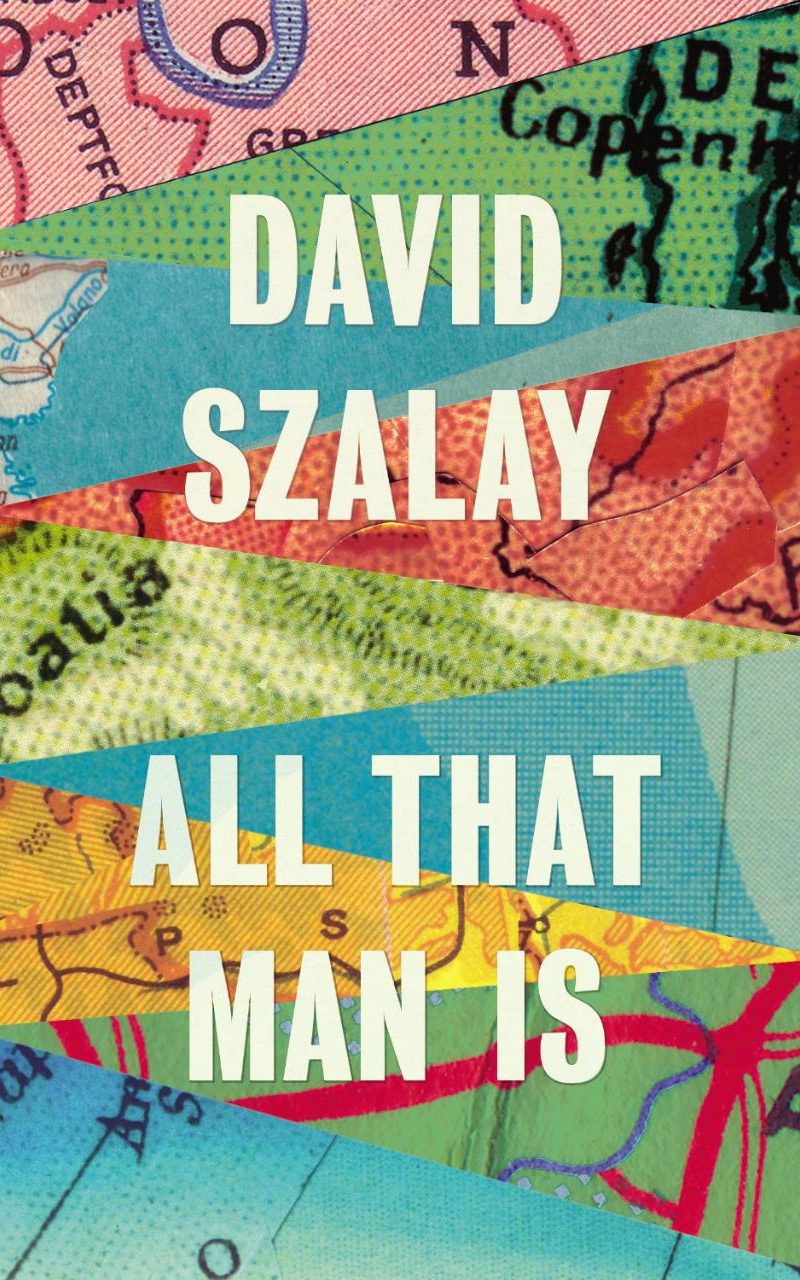
All That Man Is – David Szalay
 READ FOR BOOKERTHON
Nine men, each at a different stage of life, each of them away from home, try to understand what it means to be alive. A examination of the male experience from the spring of youth to the winter of old age.
➤ “I felt pretty wary coming into All That Man Is, a particularly male-focused read with nine separate stories about characters who seem loosely linked by a few commonalities and themes.
“In a nutshell you could say this was a book about the stereotypical interests of men….fast cars, super-yachts, private jets and of course sex – whether longingly imagined or intensely experienced.
“The author delves deeper though into the insecurities and fears that are faced by men of all ages (European and heterosexual ones anyway).
“It’s pretty horrible of me to say, but it was quite refreshing to see alpha-males fail so spectacularly when they are portrayed in most other media as being all-powerful and domineering. The women in these characters’ lives had their shit sorted in a way that the men could only wish for.
“Overall I enjoyed what felt like a unique and unfiltered look into the male psyche, in all its uncomfortable and messy glory.” – Suzy
Yesterday he experienced a sort of dark afternoon of the soul. Some hours of terrible negativity. A sense, essentially, that he had wasted his entire life, and now it was over. The sun was shining outside.
➤ “So, a short story collection is shortlisted for the Man Booker. A short story collection disguised as a novel no less. Apparently links exist between some of the characters, but they are difficult to pick.
“As a short story collection, All That Man Is is a fine example. The stories deliver what they promise, men analysing what this thing called life is all about, each in a different city, societal group and moment in time. Their dilemmas are real and eloquently portrayed and actually reveal insight into deeper reckonings some men may have. It certainly held my attention throughout all 400-odd pages. The book is very masculine though, with women given only secondary and sex-based roles in every story – don’t worry there was no mistreatment, rather the women were all self-assured characters.
“Abilities of the author acknowledged and put aside, I still come back to the fact that this is a book of nine short stories not a novel.” – Rachel
—–
Published 2016
Jonathan Cape
448 pages
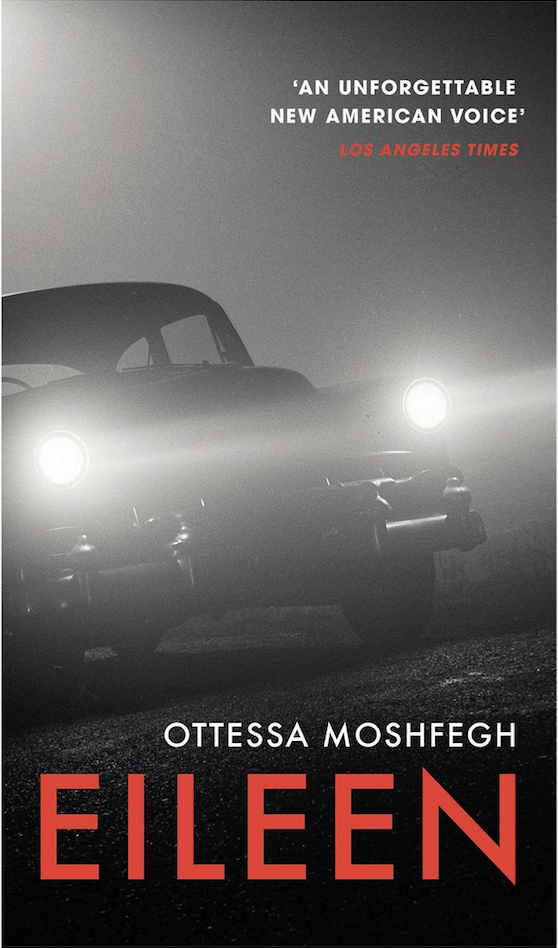
Eileen – Ottessa Moshfegh
 READ FOR BOOKERTHON
Eileen Dunlop is an unassuming yet disturbed young woman trapped between her role as her alcoholic father’s caretaker in a home of squalor and her day job as a secretary at a Boston boys’ prison. A character study of a lonely young woman in the 1960s and her harrowing story of obsession.
➤ “Eileen is unexceptional, unfulfilled and unhappy. She leads a boring and monotonous life, however is one of the most fascinating and interesting fictional characters I’ve come across in years. She was so pitiful I felt exhilarated by her triumphs, no matter how minor they were.
“The novel’s sense of impending doom had me desperately looking for clues along the way as the author slowly revealed key pieces of information. When a major knockout of a storyline was revealed I was shocked in the same way I felt with We Are All Completely Beside Ourselves by Karen Joy Fowler (shortlisted in 2014).
“Eileen the character is unheroic and tragic. Eileen the novel is bloody great.”– Suzy
Furthermore, as is typical for any isolated, intelligent young person, I thought I was the only one with any consciousness, any awareness of how odd it was to be alive, to be a creature on this strange planet Earth.
➤ “Eileen is a fabulous character study of a down-trodden, mentally unstable woman suffering from multiple repressions. Eileen, our unreliable narrator, becomes obsessed by one person after another, manoeuvring her day to day rituals around running into or observing her latest victim, all the while exhibiting strange and creepy personal behaviours and thoughts. So far, so good. In fact, excellent. This is my kind of book.
“However, we get to 43 pages before the end of the book and NOTHING HAS HAPPENED. The crux of the story is noted on the back cover blurb (ggrr pet hate) yet has still not occurred. Until then it’s purely back story and a character study, albeit superbly done. My mistake of reading the blurb ensured I was constantly searching for a plot that didn’t exist.
“But if I remove my pre-conceived expectations and look at the book for what it is, it is excellent. Thrilling, tragic, beautifully written and with the ultimate creepy antagonist. I’ve thought about Eileen a lot since finishing so it’s certainly got under my skin. Read it, just don’t read the back cover!” – Rachel
—–
Published 2015
Penguin Press
272 pages
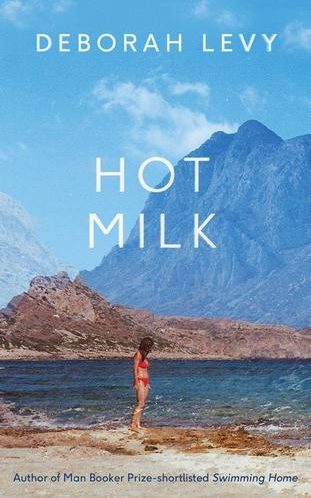
Hot Milk – Deborah Levy
 READ FOR BOOKERTHON
Sofia, a young anthropologist, spends much of her life trying to solve the mystery of her mother’s unexplainable illness. A trip to Southern Spain to see a specialist allows her to consider her own desires and plans for the future.
➤ “Hot Milk has that kind of pleasantness about it that makes it neither beautiful enough to be outstanding, nor horrible enough to be outstanding. Interesting plot, nicely written, easy to read. Pleasant.
“What was interesting was the study of a woman’s propensity for servitude. A woman so heavily controlled and influenced by her mother to the point of repression and internal rage. Sofia’s responses were predictable and totally human.
“But again I return to that word pleasant. That may be good enough for mass sales but I don’t know if it hits the mark when it comes to the Man Booker.” – Rachel
I have researched aboriginal culture, Mayan hieroglyphics and the corporate culture of a Japanese car manufacturer, and I have written essays on the internal logic of various other societies, but I haven’t a clue about my own logic.
➤ “I have never really had a good experience with the ‘young confused woman trying to find herself’ genre, but Hot Milk was a pleasant surprise. I finished it feeling a bit neutral but the more I have reflected on it, the more I appreciate it.
“There are some crazy threads running through the book, some of which will honestly haunt me forever, but the absurdity of the storyline is somehow relatable and overall there was a lovely rhythm and pace to the writing.” – Suzy
—–
Published 2016
Penguin Random House
214 pages

We're
currently
reading
 The Free-Range Bookclub
Recent Comments