The Free-Range Bookclub
Bookclubbers without boundaries in Nelson, New Zealand
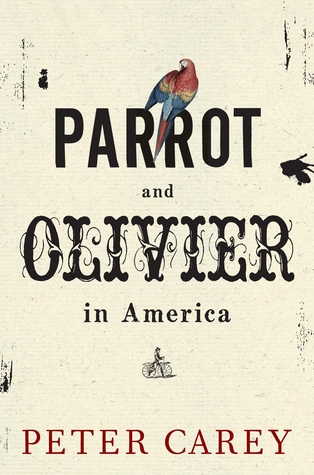
Parrot And Olivier in America – Peter Carey
 READ FOR BOOKERTHON
Olivier, a French aristocrat, sails for the New World with his servant Parrot
☁ “Olivier-Jean-Baptist de Clarel de Barfleur de Garmont is a young French nobleman who attends democratic lectures in his homeland and is suspected of being a spy. He is advised to move to away from the unwanted attention, as far away as America. He does so, taking with him John Larrit, aka Parrot as a secretaire, whose family printing business went up in flames.
On the ship the men lament the friends and lovers they have left behind, though there are a few surprise re-appearances, and also new turmoil and lustful adventures on the long voyage.
Once in the New World the men decide to investigate the penal system but struggle to agree upon their journeys and exploits, which more often than not turn out to be troublesome. The men quarrel and make up, collecting women and friends/enemies along their adventures.
The story is told in first person by Parrot and Olivier in alternating chapters, each portraying their unique perspective on events. Their narratives highlight one of the book’s main themes, the class difference between aristocrats and commoners. In the New World they agree to arrive as friends rather than master and servant however, the way in which the men treat others and view rules and laws demonstrates that behaviours related to class division are difficult to let go of.
I have traveled widely. I have seen this country in its infancy. I tell you what it will become. The public squares will be occupied by an uneducated class who will not be able to quote a line of Shakespeare.
Rachel and Suzy both agreed the book was full of fabulous characters, was well-paced and full of intrigue. However Rachel’s attention wavered and she didn’t pay as much attention as she should have to the details, affecting her overall view of the book. Suzy on the other hand was enthralled with the characterisation and the adventures and captivated throughout, noting it as a substantial literary and historical work.
—–
Published 2009
Hamish Hamilton
464 pages

We're
currently
reading
 The Free-Range Bookclub
Recent Comments